
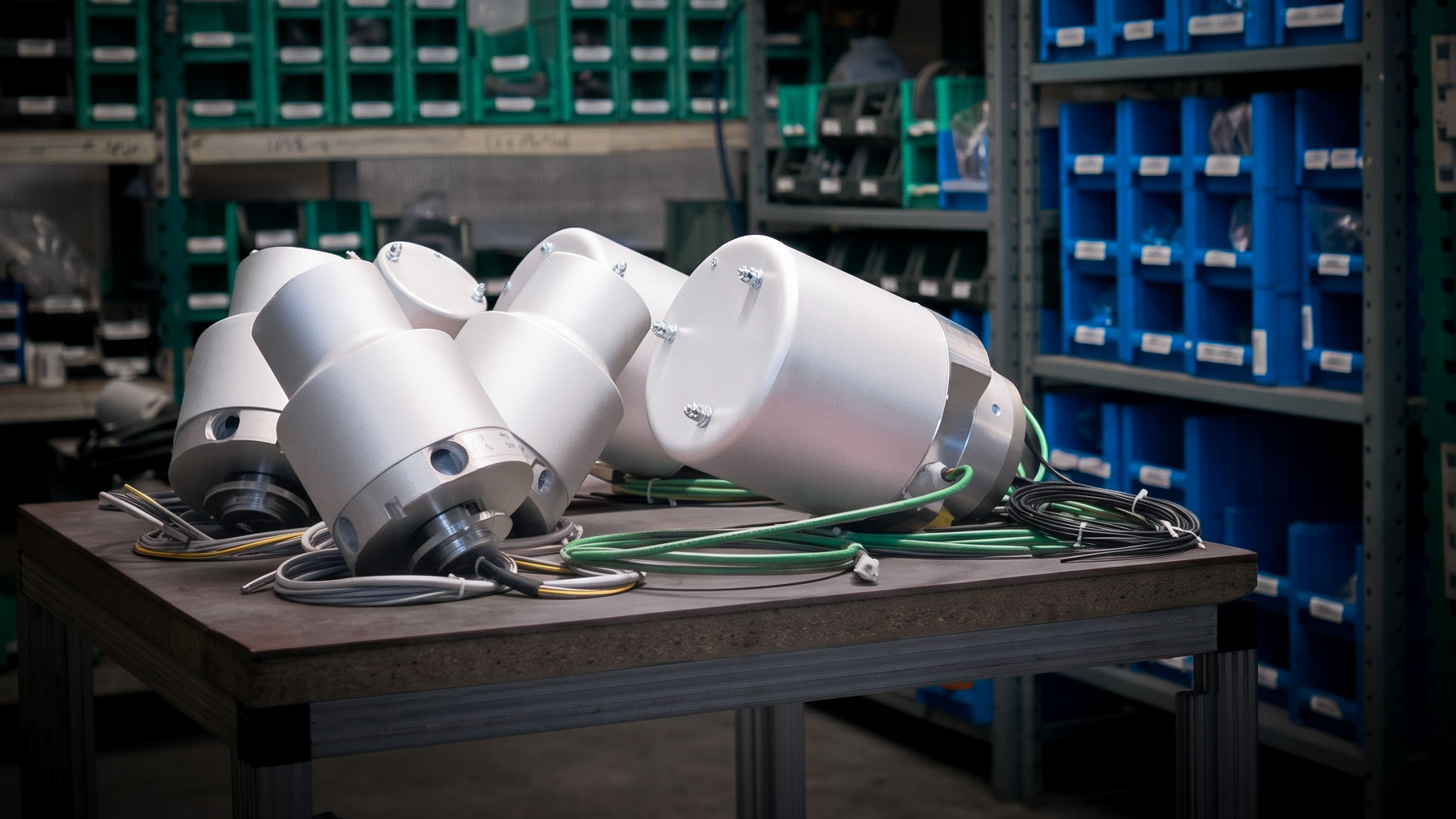
Data transmission via slip ring in Industry 4.0
Sensors, motors, servo drives, and control systems need to exchange information even when located on continuously rotating parts. Data transmission via slip ring allows connecting these devices from the stationary part of the machine to the rotating one, avoiding cable twisting. In Industry 4.0, a slip ring can be required to handle analog measurements and digital communications, such as CAN bus or industrial Ethernet networks, including Profinet, Profibus, EtherCAT, and EtherNet/IP. Each connection has specific requirements: electrical continuity is essential, but it is also necessary to preserve signal quality during rotation.
Analog, digital, and power signals: different needs
An analog signal represents a physical quantity through a continuous value, for example, a 0–10 V voltage or a 4–20 mA current. Superimposed noise can alter the measurement, where noise is defined as an unwanted electrical disturbance that superimposes on the useful signal, modifying its voltage or current. In a machine, this can be generated, for instance, by motors, inverters, or electrical switching. Inside the slip ring, even small variations in the contact between brushes and rings can contribute to signal perturbation. The effect of cable and contact resistance, on the other hand, depends on the circuit. 4–20 mA connections are generally less sensitive to resistive drops compared to voltage signals, provided the power supply maintains the necessary operating margin. Digital signals encode information into discrete states and tolerate a certain amount of noise. However, if the receiver’s margins are exceeded, communication errors can occur. Therefore, there is no absolute superiority of analog or digital: what matters is the interface, the speed, and the operating environment. Power circuits have a distinct function, which is to feed loads, and require close attention to current, voltage drops, and heating.
Electrical noise and crosstalk: why the path matters
During rotation, variations in contact resistance can introduce disturbances. Added to these are interferences from nearby motors, inverters, and circuits. Crosstalk is the unwanted coupling through which one circuit disturbs another. In high-speed digital connections up to 100 Mbps, like Ethernet, impedance, attenuation, and signal reflections also become critical. The slip ring must therefore be evaluated as part of the entire connection, along with cables and connectors. Circuit layout, maintaining twisted pairs, and properly connected shielding all contribute to preserving communication integrity.
The Celco approach: custom contacts and configuration
Celco markets standard slip rings and also develops custom ones based on currents, signal types, rotation speeds, and environmental conditions. This analysis allows us to define a solution that is perfectly consistent with the machinery and the connections to be established. When choosing contact technology, pairings like gold-on-gold can facilitate low electrical noise; silver-based solutions must be evaluated according to the load and operating conditions. The choice must be completed with wiring suitable for the protocol and an internal layout that minimizes the coupling between power and data. Materials, cables, and shielding for the specific configuration must be agreed upon with the technical department: the contact metal alone does not determine compatibility with an industrial network.
Do you need a hybrid slip ring for power and signals?
A hybrid power and signal slip ring allows you to combine power supply and communication within the same rotary assembly. To define it correctly, you need to specify voltages and currents, number of circuits, signal type, protocol, transmission speed, and cable length, in addition to mechanical and environmental constraints. Contact Celco’s technicians to evaluate your project. Sharing these data right from the early stages allows us to identify the right configuration and the necessary verifications to seamlessly integrate the slip ring into your automation system.